The Big Banks at the UNFCCC financing the climate crisis & violence
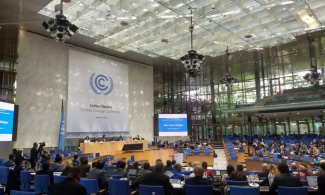
Twenty of the world’s biggest banks that attended COP30 in Belém financed $409 billion in fossil fuels in 2024, nearly half of the world’s total fossil fuel financing by big banks.
More than 1600 fossil fuel lobbyists were granted access to the COP30 climate talks in Belém just six months ago. This was the largest concentration of fossil fuel lobbyists at any COP since Kick Big Polluters Out (KBPO) began analysing conference attendees.
Between 2021 and 2024, there were over 5,350 fossil fuel lobbyists who attended COP26 to COP29, including representatives from 180 oil and gas corporations. Just 90 of those corporations were responsible for nearly 60% of global oil and gas production in 2024. These are the largest oil and gas corporations fueling the climate crisis, walking the halls of the climate talks freely, every year.
Despite claiming to be part of the climate solution for over a decade now, the oil and gas industry has yet to make any real strides towards renewable energy production, with the largest 250 oil and gas companies only owning a marginal 1.42% of the global renewable energy capacity in operation. Global oil and gas production is still largely on the rise.
It’s not only fossil fuel corporations that are roaming the halls of the United Nations Framework Convention on Climate Change (UNFCCC). Every year at the UNFCCC climate talks, a myriad of actors actively extend the lifeline of the fossil fuel industry. This is especially true in the banking sector.
KBPO matched the KBPO Fossil Fuel Lobbyist data with Banking on Climate Chaos’ (BOCC) fossil fuel financing data for 2024 to illustrate just how complicit big banks attending the UN climate talks are in fueling the climate crisis.
According to the BOCC data released in 2025, the world’s 65 largest banks have financed $868.75 billion worth of fossil fuel transactions (such as corporate financing, project financing, merger and acquisition financing) in 2024, making up the majority of global fossil fuel financing. [1]
Twenty of the world’s biggest banks that attended COP30 in Belém financed $409 billion in fossil fuels in 2024, nearly half of the world’s total fossil fuel financing by big banks.
On average, 44% of this financing went to fossil fuel expansion, such as new oil and gas exploration, despite the International Energy Agency’s repeated calls to end new oil and gas developments.
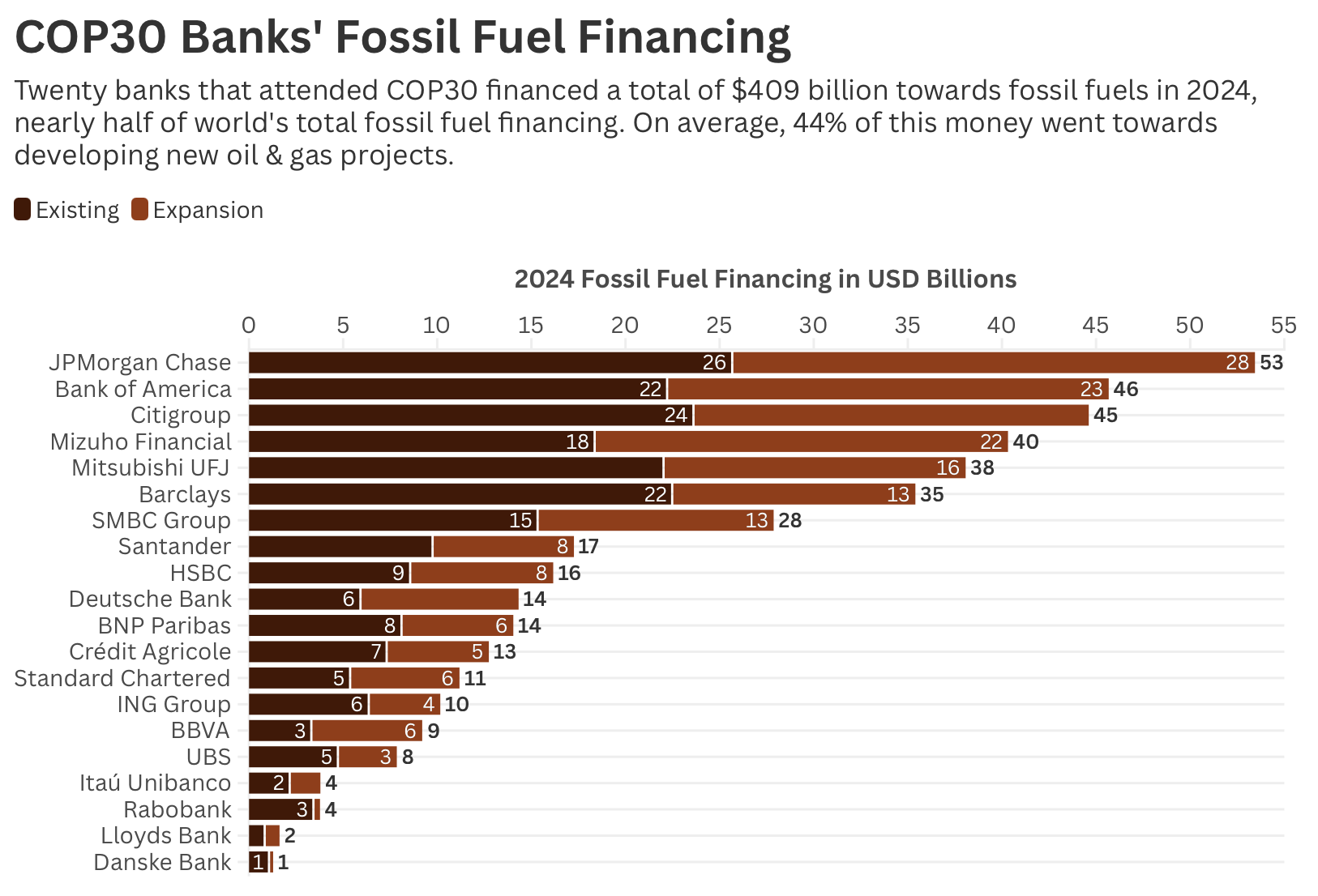
Source: KBPO. Data from Banking on Climate Chaos 2025, and Kick Big Polluters Out 2025. Chart made in Flourish.
Fossil fuel financing by these banks is not a minor part of their portfolios. In 2024, JPMorgan Chase financed nearly 750 different fossil fuel companies, totalling $53.44 billion, and ranked as the worst fossil fuel financier. Bank of America financed over 350 different fossil fuel companies, while Barclays financed over 200 and HSBC over 130. These bank representatives host and attend UNFCCC side events and panels, and influence climate negotiations in a way that maximises their profit model, a good portion of which is the expansion of oil and gas development.
The overall support from these banks for the fossil fuel sector is likely much larger, since financing only covers transactions such as lending, bonds, and share issuances. It does not include fossil fuel investments, which many of these banks also make through their asset management arms.
Between 2021 and 2024 18 of the 20 banks pumped a combined $180.7 billion into oil and gas companies that were themselves also at COP30. [2]
These are not arms-length transactions. These banks and their fossil fuel clients are locked into close, mutually dependent business relationships. Each side has a direct financial stake in outcomes that preserve a fossil fuel business model.
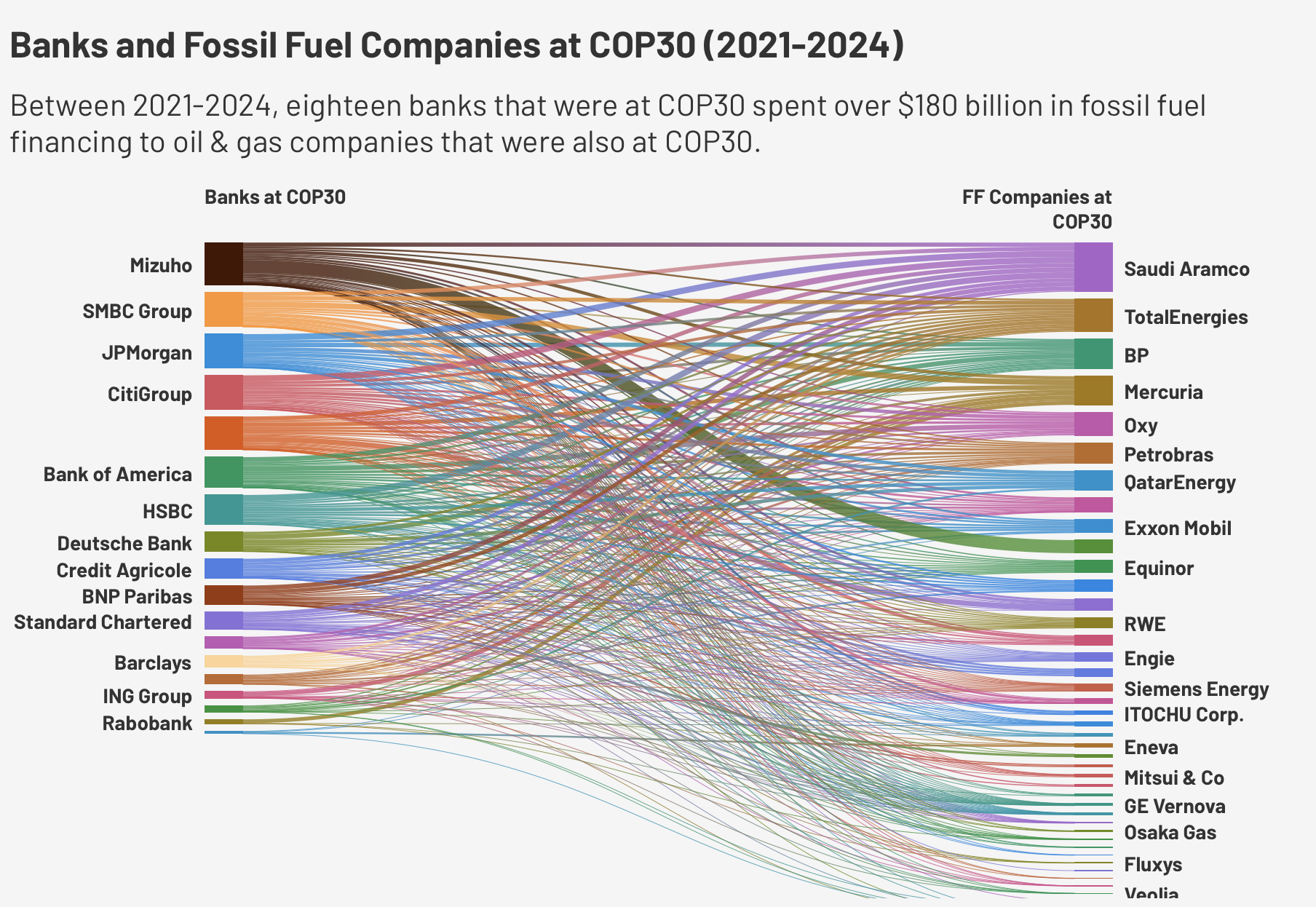
Source: KBPO analysis using data from Banking on Climate Chaos 2025 and Kick Big Polluters Out Fossil Fuel Lobbyist Data 2025. Chart made in Flourish.
North American and European banks fuelling the climate crisis.
Of the 20 major fossil fuel financiers that attended COP30, all but four were headquartered in Europe or North America. This geography matters as capital flows out of Wall Street, London, Frankfurt, and Paris into oil and gas projects whose emissions warm the entire atmosphere but whose damages disproportionately impact those least responsible for climate change.
While fossil fuel financiers are undermining action, communities most affected by climate change are often even not in the room when decisions get made. As big banks profit alongside their fossil fuel clients and negotiate for higher profit margins, the communities on the frontlines of climate change are asked, year after year, to negotiate for their survival against the very actors financing the crisis closing in on them.
LNG expansion in the Philippines
Several banks attending COP30 including JPMorgan Chase, Mizuho, and ING Group, are enabling the destructive LNG expansion in the Philippines, right beside the Verde Island Passage, a global biodiversity hotspot known as the “Amazon of the Oceans.” Expansion plans from Shell (another COP30 attendee) and dozens of other oil and gas companies, which includes the build-out of LNG terminals, jetties, and gas plants is already damaging coral reefs, raising spill risks in a region that recently saw disasters, and pushing local communities out of their fishing grounds while exposing residents to pollution and illness from the existing gas plants. Companies involved have even constructed illegally without proper permits.
For a country already among the most climate-vulnerable in the world, LNG locks the Philippines into an even higher risk future making these banks directly tied to ecosystem destruction, community harm, and worsening climate risk.
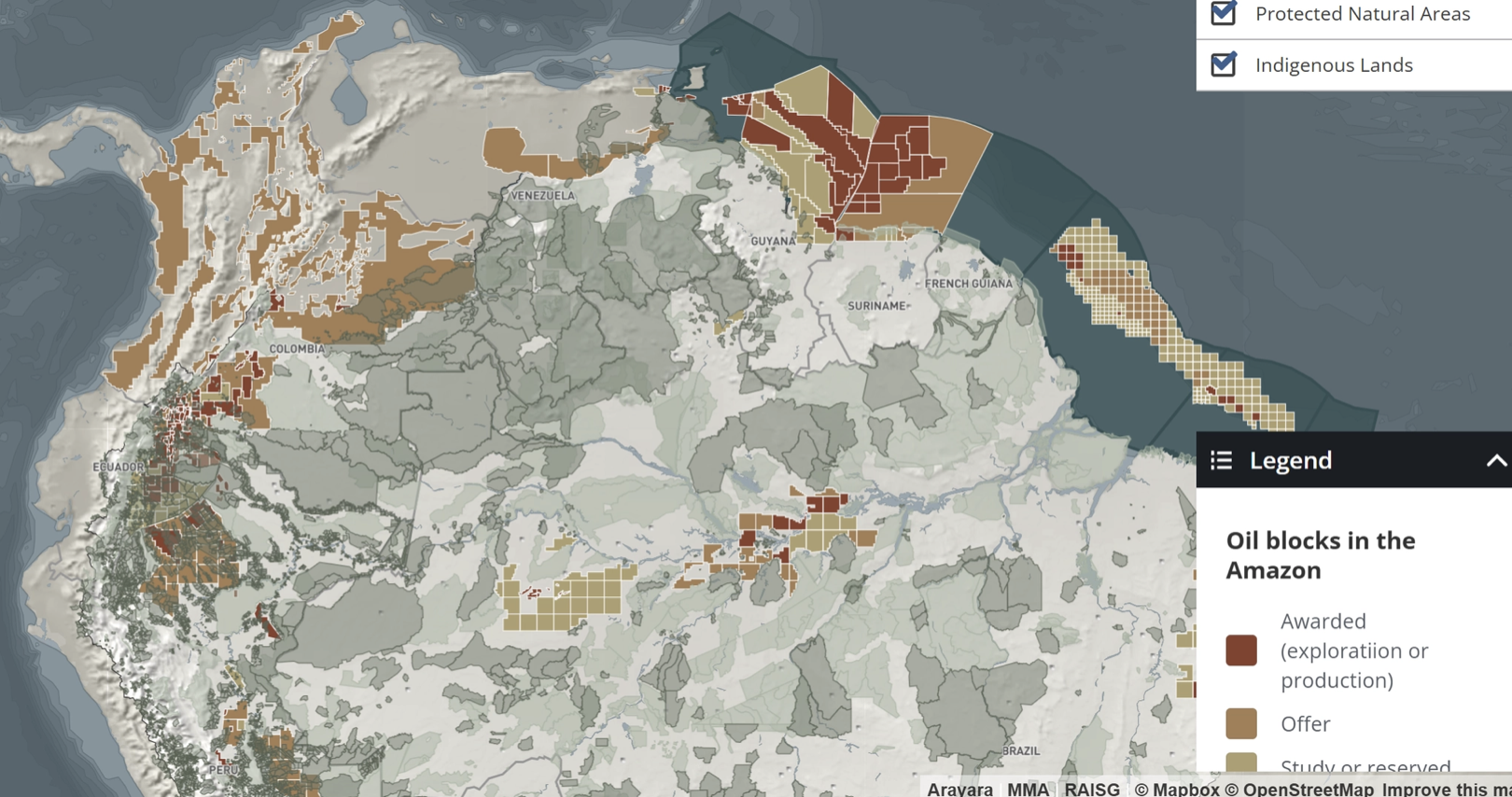
Source: InfoAmazonia, Every Last Drop
Oil expansion in the Amazon
Major lenders with direct access to the climate negotiations in Belém, Brazil last year such as HSBC, Santander, Deutsche Bank, and UBS, are also financing oil expansion in the Amazon rainforest. The banks’ financing is enabling one of the world’s most destructive fossil frontiers, in a region where oil companies have historically caused catastrophic spills. These include Ecuador’s 2020 disaster that destroyed the livelihoods of 27,000 Indigenous people.
Across the Amazon, hundreds of oil blocks in Brazil, Peru, and Ecuador continue to threaten the lives of thousands of Indigenous peoples, with many communities having already faced severe health conditions due to toxic nearby wells. In Brazil, oil companies are now targeting the mouth of the Amazon where 25% of a 9,300 km² coral reef system which hides under opaque waters overlaps with the oil and gas blocks. Despite lack of consent from Indigenous peoples and ongoing legal disputes over social and environmental harms, HSBC and other banks continue to finance the expansion of fossil fuel extraction into the Amazon biome.
Some of the oil and gas companies involved in the Amazon biome and coastal fossil fuel expansion, such as China National Petroleum Corporation, SK, Gazprom, Petrobras, Chevron, Exxon, and BP, were all granted access to COP30; many of these are financed by fossil banks also attending COPs year in and year out.
Greater Tortue Ahmeyim (GTA) LNG megaproject
Bank of America, Mitsubishi UFJ Financial, and Sumitomo Mitsui Financial Group (SMBC Group) - all attending the COP30 climate negotiations last year - are just a few of the financiers behind BP’s (another COP30 attendee) Greater Tortue Ahmeyim (GTA) LNG megaproject between Senegal and Mauritania, an ultra-deepwater development tapping into a reserve that holds 425 billion m³ of fossil gas, with plans to expand into a basin holding up to 1,133 billion m³. If burned, these reserves would emit 2.2 billion tons of CO₂.
The project threatens some of West Africa’s most critical ecosystems, including the world’s largest cold-water coral reef, a 580 km long and 200,000-year-old formation, and multiple national parks and UNESCO-protected areas. Local fishing communities, already facing collapsing stocks, are being pushed out by exclusion zones, loss of fish, and zero compensation. A condensate spill from this project has the potential to pollute the coasts of up to nine countries within a week, per the project documents. By backing this project, these banks are directly committing to continued fossil fuel expansion and massive climate risk across West Africa, all while participating in the climate talks.
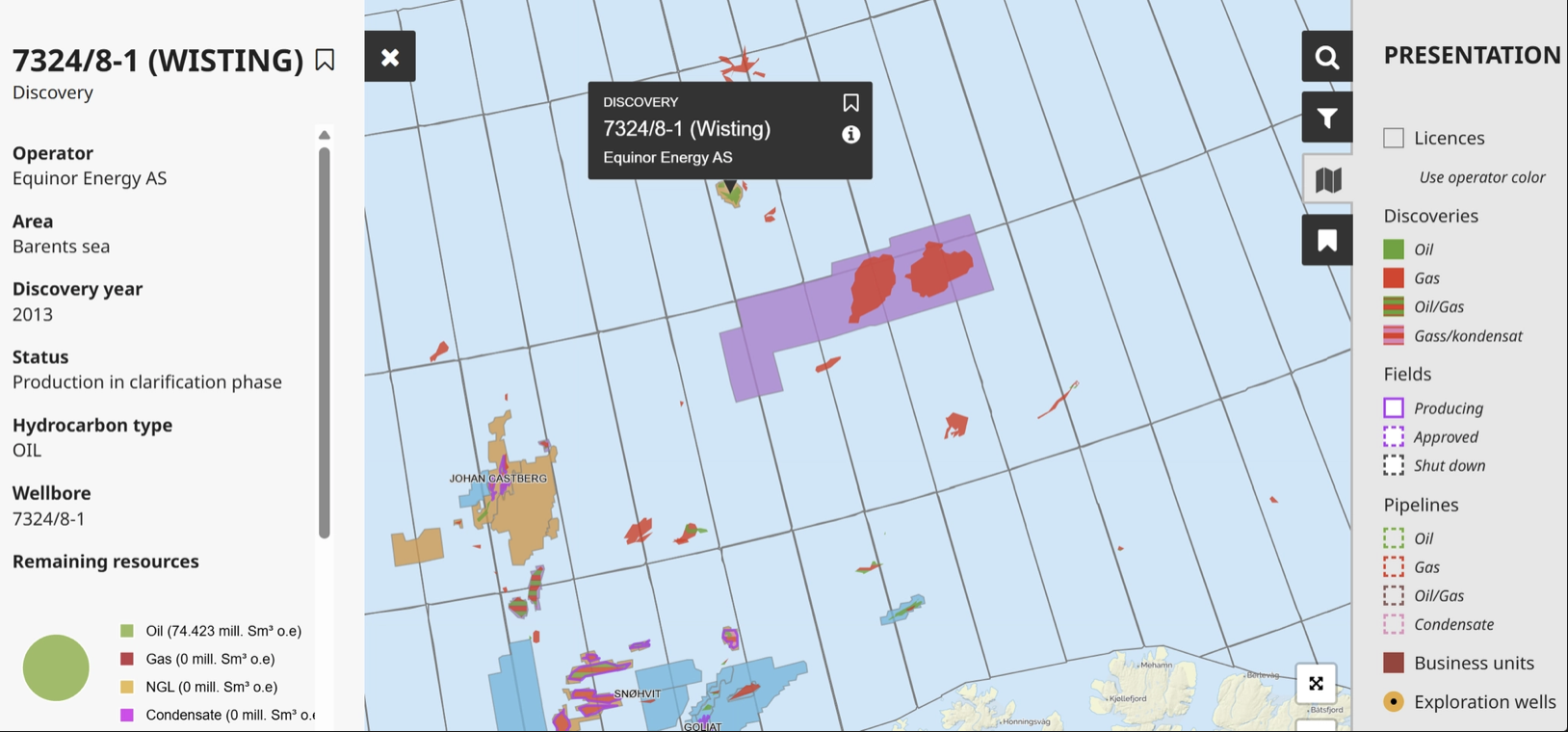
Source: Norskpetroleum
Arctic - Wisting oil field
Barclays, along with BNP Paribas, Crédit Agricole, and Standard Chartered were all granted access to COP30, despite all being involved in financing Equinor’s (also a COP30 attendee) push into the high Arctic through the Wisting oil field.
Wisting would expand Arctic drilling despite the region warming four times faster than the rest of the planet, and directly threaten the Marginal Ice Zone, a key ecosystem only 125 km from the field.
Experts warn that an Arctic spill could be impossible to clean, with winter seas reaching 10-meter waves and temperatures of –25°C. Industry data shows only 11.5% of Barents Sea licences ever lead to viable production, but Barclays’ continued financing keeps Equinor’s Arctic expansion alive despite massive ecological risk and the threat of irreversible damage to one of the planet’s most important and vulnerable climatic regions.
Fossil fuel financiers, and other fossil fuel enablers attending the UNFCCC talks have no role to play in climate negotiations while their profit model depends on successful oil and gas exploration and expansion.
Beyond climate: Fossil fuel financiers also bankrolling war and human rights atrocities.
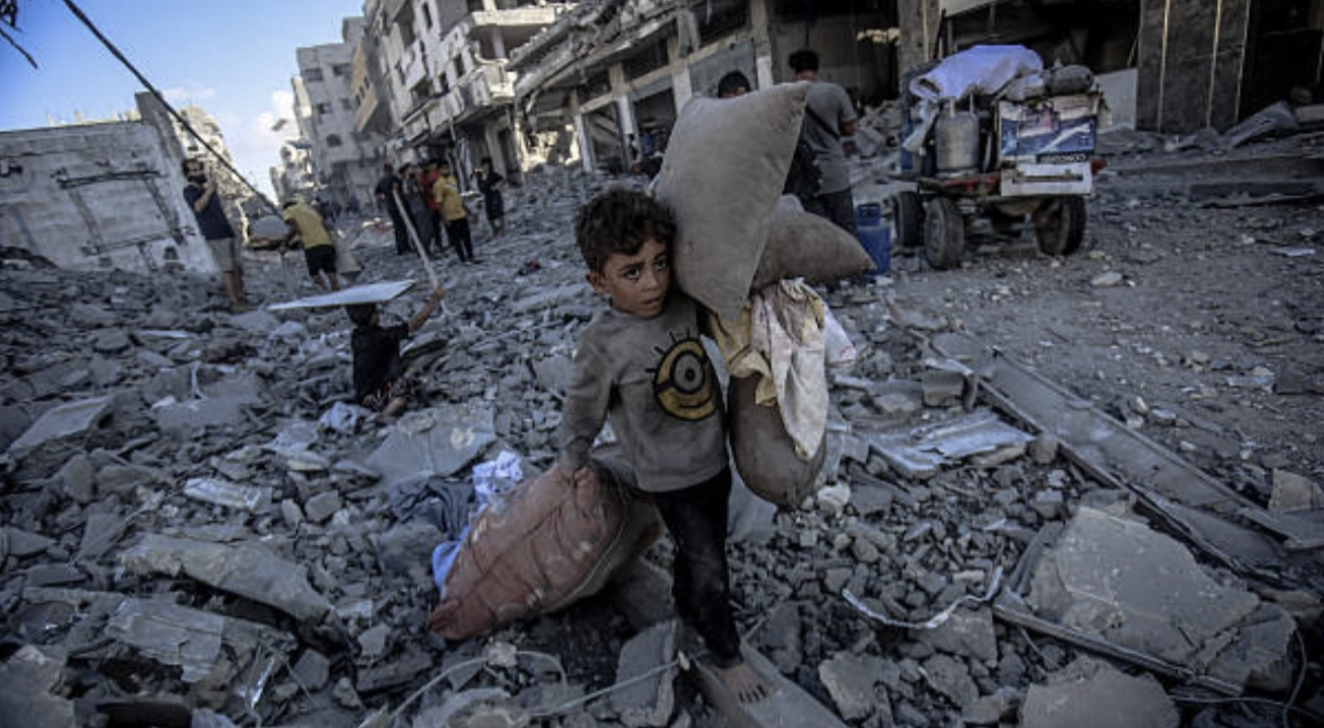
Photo by Saeed M. M. T. Jaras/Anadolu
Several of the same banks granted access to COP30 are also named in current court findings, regulatory actions, and watchdog research as financiers of armed conflict, sanctions evasion, illegal occupation, human rights atrocities, and weapons production. Their fossil fuel financing is, in other words, only part of a larger pattern.
In October 2025, a federal jury in the Southern District of New York found BNP Paribas liable for enabling the genocidal atrocities committed against Black African civilians in Sudan, paying $20.75 million to three Sudanese-refugee plaintiffs in a class action representing over 23,000 Sudanese refugees living in the United States. The jury’s verdict is among the first of its kind to hold a global bank civilly liable for financially enabling human rights abuses.
Several other COP30-attending banks are named in research linked to the genocide in Gaza, and in the wider occupation of Palestine.
The Don’t Buy into Occupation IV coalition report identifies BNP Paribas, HSBC, Barclays, and Deutsche Bank, Santander, Standard Chartered, ING Group, and BBVA as some of the largest European creditors, by volume of lending and underwriting, to companies operating in illegal Israeli settlements.
A separate Profundo investigation published by BankTrack and PAX identifies seven international banks, including COP30 attendees JPMorgan Chase, BNP Paribas, Barclays, Bank of America, Deutsche Bank, and Citigroup, that together underwrote $19.4 billion of Israeli sovereign “war bonds” between October 2023 and January 2025, debt issued in part to cover the costs of the Gaza genocide.
On the arms-financing side, a May 2024 report by Palestine Solidarity Campaign, Campaign Against Arms Trade, and War on Want found Barclays then held over £2 billion in shares and provided £6.1 billion in loans and underwriting to nine arms companies supplying Israel, including £2.7 million directly in Elbit Systems (armoured drones, munitions and artillery weapons) and over £100 million in General Dynamics (gun systems for the fighter jets used by Israel to bomb Gaza).
The same banks asking to be trusted as climate partners are, by court verdicts, regulatory action, and credible civil-society research, also financing wars, weapons, genocide, and occupation. Their profit model depends not only on the continued expansion of oil and gas, but on continued violence. Unfortunately, there is no banking alliance or ESG mechanism that survives this type of track-record, and their bankrolling of global crises makes these bank controversial if not incredibly unfit for negotiating a healthier climate and society.
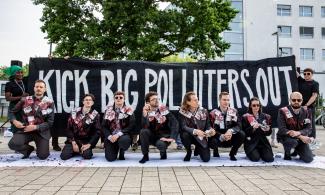
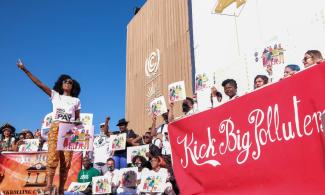
It’s time to weed out the influence of Big Polluters and their enablers. No more writing the rules of climate action. No more bankrolling the climate talks. It’s time to reset the system so it works for people and the planet.
Notes:
Top photo credit: David Tong, Oil Change International
[1] BOCC covers the world’s 65 biggest relevant banks by assets, according to the S&P Global Market Intelligence ranking from April 2024. Banks with less than $150 million league credit reported in Bloomberg LP for economy-wide financing were deemed irrelevant.
[2] In its public dataset, BOCC distinguishes between parent company and subsidiary financing. For this research, KBPO fuzzy matched and grouped subsidiaries with parent companies within the BOCC data. For example, BOCC data that indicates bank financing towards Saudi Arabian Oil Company, Saudi Aramco Base Oil, and Saudi Aramco Total Refining and Petrochemical, is represented in this research as bank financing towards Saudi Aramco. However, in the interest of time, subsidiaries that may appear in BOCC data but contain entirely separate names than their parent company were not grouped under that parent company. This means that fossil fuel financing towards these parent companies is likely greater than what is shown in this research. In the case of merger operations, such as Saudi Aramco Total Refining and Petrochemical, the first company name is chosen as the parent company.